Trust & Verification
Draft specifications for how we approach verifiability. Threat models, artifact formats, determinism requirements, energy measurement, and our data collection policy.
Note: This page reflects design goals and draft specifications. Implementation is in progress and may change.
Threat Model
What We Protect Against
- ✓Unauthorized data exfiltration during inference
- ✓Undetected modification of model weights or adapters
- ✓Configuration tampering without audit trail
- ✓Non-reproducible inference runs
- ✓Log deletion or modification
What We Do Not Claim
- ✕AI outputs are “true” or “correct”
- ✕Protection against hardware-level attacks
- ✕Protection against malicious operators with root access
- ✕Model safety or alignment guarantees
- ✕Perfect numerical reproducibility across architectures
Field notes from customer and operator interviews:
- "People want the tech, but they do not trust it yet." — Product stakeholder, regulated enterprise
- "IT is spearheading AI governance, and teams follow once controls are published." — Technical director, enterprise integrator
- "Every employee signs our AI directive." — Senior vice president, component manufacturer
Artifact Chain
The draft spec defines a proof pack with cryptographic hashes linking inputs to outputs.
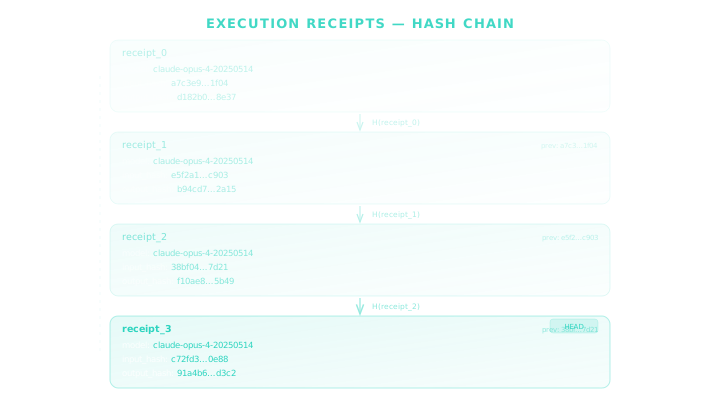
Proof Pack Structure
{
  "version": "1.0.0",
  "timestamp": "2025-11-12T14:32:01Z",
  "input_hash": "sha256:a7b9c3d4e5f6...",
  "model_hash": "sha256:1a2b3c4d5e6f...",
  "adapter_hash": "sha256:9f8e7d6c5b4a...",
  "runtime_hash": "sha256:0123456789ab...",
  "config_hash": "sha256:fedcba987654...",
  "output_hash": "sha256:abcdef012345...",
  "signature": {
    "algorithm": "Ed25519",
    "public_key": "MCowBQYDK2VwAyEA...",
    "value": "base64:signature_bytes..."
  },
  "previous_hash": "sha256:chain_link..."
}
Determinism Requirements
Fixed Seeds
Random number generators are intended to use declared seeds. Seeds are recorded in the proof pack.
Pinned Versions
Runtime, model, and adapter versions are intended to be pinned and hashed. No floating dependencies.
Declared Tolerances
Numerical tolerances are documented. Expected variance is specified per operation.
Note: Bit-exact reproducibility is not guaranteed across different hardware. We specify tolerances and document expected variance for cross-platform deployments.
Energy Measurement Method
Joules per token provides a hardware-normalized efficiency metric. Our methodology is designed for repeatability on macOS.
Measurement Steps
- Thermal stabilization: 5 minutes idle before measurement
- Baseline capture: 30 seconds of idle power via
powermetrics - Workload execution: Run inference with fixed input batch
- Power sampling: 100ms intervals during inference
- Calculation: (Total energy - Baseline energy) / Token count
- Averaging: Report mean of 10 runs with standard deviation
Required Reporting
- • Hardware model and chip variant
- • macOS version
- • Ambient temperature range
- • Power adapter state
Repeatability Rules
- • Same hardware for comparison
- • Same thermal conditions
- • Same input data
- • <5% variance between runs
No Third-Party Collection
Explicit Statement: This website does not include third-party tracking scripts, analytics pixels, or telemetry that reports to external services. adapterOS is designed without them.
We do not use Google Analytics, Facebook Pixel, Mixpanel, Segment, or similar services.
Allowed Minimal Logs
Minimal server access logs for security and debugging. IP addresses, timestamps, request paths. Typically retained for 30 days. Not shared with third parties.
Opt-In Only
Contact form submissions are stored to respond to inquiries. Newsletter signup is explicit opt-in only. No pre-checked boxes.